Showing posts with label Enterprise. Show all posts

Tuesday, 31 March 2015

Microsoft Simplifies Visual Studio Lineup And Pricing For Enterprise Users

Postmates Will Deliver Bastian Lehmann Via Bike To The Disrupt New York StageMicrosoft today announced that it will consolidate its Visual Studio Premium and Ultimate offerings for enterprises into a single product once it launches Visual Studio 2015 later this year. Now called Visual Studio Enterprise With MSDN, this new version will include all of the features developers were getting with Visual Studio Ultimate (IntelliTrace in production, CodeLense support, etc.).
It’s also dropping the price of this new Enterprise version to slightly below the old price of the Premium edition. Enterprise with MSDN will now cost $5,999 for the first year and $2,569 for subsequent years (the old price for Premium was $6,119 for the first year and $2,569 from then on). That’s a 55 percent price drop for current Ultimate subscribers.
The price of Visual Studio Pro, the company’s offering for individuals and smaller teams, will remain at $1,199 for the first year and $799 for renewals.
It’s worth noting that Microsoft will continue to offer a standalone, non-subscription version of Visual Studio Professional, too, for $499.
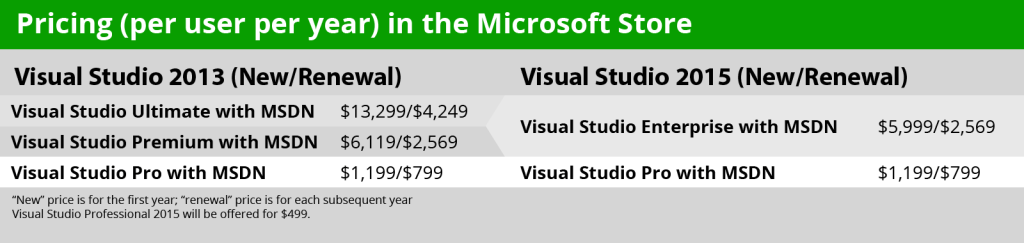
visual-studio-table
Now there’s one wrinkle to this story. Enterprises that currently have volume licensing deals are probably getting a better price for Premium right now than for the new Visual Studio Enterprise edition. Microsoft tells me that the typical user there pays $3,573 for the first year and $1,312 for the renewal and that it expects the volume price for Enterprise to be $4,466 (and $1,640 for renewals).
As Microsoft’s general manager for Cloud and Enterprise Developer Platform Marketing and Worldwide Sales Mitra Azizirad told me earlier this month, the company will offer these Premium users the ability to renew their subscription at the old price for the calendar year after the launch of Visual Studio 2015. After this renewal, they will be paying roughly 25 percent more than they are now for the Enterprise version, but the company argues that they are also getting far more features than before.
Azizirad noted that Microsoft’s enterprise customers had been asking for a better way to standardize their Visual Studio deployments across the company, and today’s announcement reflects its attempt to address this.
Last year, Microsoft probably made its boldest Visual Studio move yet when it launched an (almost) fully-featured free Community edition of the application that included support for extensions — something the previous (and very limited) free versions never offered. Microsoft tells me that it has seen over 2 million downloads of the Community edition since it launched.
Related ArticlesMicrosoft's Visual Studio Online Now Lets Developers Add Unlimited Stakeholders For FreeMicrosoft Previews New Azure Portal, Integrates Visual Studio Online And Basic Code EditorMicrosoft Updates Azure With Deeper Visual Studio Integration, Puppet And Chef Support
As part of the Visual Studio 2015 updates, some of the features that were previously only available in high-priced versions will also move down the ladder. CodeLense, for example, is now available in Visual Studio Professional and the free Community edition is getting support for PowerPoint storyboarding.
“We want to make the right moves to bring the most popular features to the most developers as possible,” Azizirad told me. “This is really a move in terms of accessibility.” She also noted that Microsoft wants to show developers that it is listening and responding to their needs.
So how does all of this work out for existing Visual Studio subscribers? Mitra tells me that all active premium customers will get a free upgrade to the enterprise version, whether they bought Premium or received it through programs like BizSpark or the Microsoft Partner Network.

The Next Billion-Dollar Market Opportunity Is Mobile Enterprise

The End Of Hardware Alley Registrations Is Nigh!Editor’s note: Kevin Spain is a general partner at Emergence Capital.
Enterprise mobile applications – like enterprise cloud applications a decade before – are poised to become a $100 billion market opportunity. I’ve worked with enterprise technologies exclusively for more than a decade and have watched as cloud apps took the enterprise by storm, giving businesses more flexibility and power than ever before.  Now, enterprise mobile is taking a page from enterprise cloud’s play book – but with a twist.
Obviously, mobile technology is less expensive, more accessible, and easier to use in many ways than cloud technology, and that makes it attractive to the enterprise. But what may not be so obvious regarding the allure of mobile for the enterprise is the degree to which it will democratize the use of technology for businesses in underserved sectors and far-flung locations.
There are more than 3 billion people globally who work in some capacity. Yet only 20 percent of them have ever had access to technology to help them perform their jobs more effectively. That leaves 2.5 billion workers not being supported by technology today. Some of them are in industries like construction, an $8 trillion a year space that spends less than 1 percent of its revenue on IT. Others are in manufacturing, the world’s fourth-largest industry with 40 million workers globally — it spends less than 2 percent of revenue on IT.
A significant portion of those 2 billion-plus workers without technology are in the developing world, with 50 percent in Asia-Pacific, 10 percent in Latin America and another 10 percent in the Middle East and Africa. This global opportunity is enormous, and mobile technology is uniquely poised to capitalize on this market as the heavy infrastructure improvements necessary for hard-wired solutions are expensive and time consuming to deploy.
Overall, we’re talking about some pretty staggering numbers, but just how big is the mobile enterprise opportunity? Consider this quick calculation. If we take the 2.5 billion workers that don’t have desk jobs and assume we can monetize each one at about $40 per year (a mere 10 percent of what is spent today on technology for a typical desk-bound worker) we’re looking at approximately $100+ billion in annual revenue.
This opportunity is vast in many ways – and it is also unlike anything we’ve seen in enterprise technology in the past. Any industry that would benefit from the features that smartphones now have can leverage an enterprise mobile solution. Industries like construction and surveying can empower their mobile workforces with camera-based technology to get fast and cheap quotes and communication to their central offices. Delivery and transportation workers can utilize mapping, billing and other phone-enabled mobile solutions to achieve greater efficiency. Healthcare is likely the largest opportunity, in India, mobile healthcare apps are taking off. In fact, 500 Startups has launched a fund dedicated to investing in mobile health in India, China and Africa.
What will it take for entrepreneurs who want to seize this opportunity and build a leading mobile enterprise company? Here are a few best practices that I have seen in some of the early leaders:
5A125B5D-DA45-4C7E-ADC9-D47CD71B7AF7
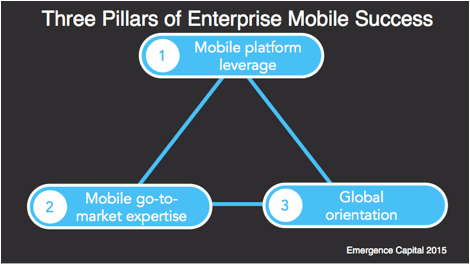
In order to best leverage the mobile platform, capitalize on what is unique about mobile devices. Consider the following:
Use the latest smartphone capabilities (e.g. sensors, cameras, GPS, voice) to your advantage. Great examples are how Shyp uses your location and that of its networked “shippers” and how Expensify uses the camera features to capture receipts.
Consider how some of the leading mobile platform providers, like Box and Salesforce can help you as you scale.
Mobile go-to-market expertise
This is just as important in the mobile arena as it is in other spaces, but there are some interesting differences.
Learn how to successfully manage app store optimization for a business user or for a business-oriented company. Tools like SearchMan, apptamin and Sensor Tower can all help you achieve optimization without a lot of time or resources.
Build a customer acquisition model that matches your offering, for example, mobile messaging company Cotap, relies on enabling viral growth through its interface.
Leverage word-of-mouth in vertical markets. PlanGrid in the construction space has grown through their customers spreading the word.
Global orientation
Most mobile enterprise developers today are not thinking much about international coverage, which can put you at a competitive advantage. There is a much more significant international opportunity in the mobile space than even in the cloud or SaaS spaces. Map out your global ambitions in the earliest days of your company, and plan how you’ll actually embed that into your organization’s DNA.
Global planning can’t be an afterthought because 70 percent of the opportunities you will be pursuing are outside of developed markets.
Localize your product or make it easy to localize. It’s very costly to retrofit a product.
Think about mirroring best practices of SaaS companies that have expanded internationally, and how these same techniques translate to mobile.
Consider a range of international go-to-market strategies before committing to one. There are different paths to success – working with a partner to be distribution arm, building local teams/hubs in each region or market, acquiring a company in another region that is doing something similar and make that your expansion strategy – choose which strategy or combination of strategies makes the most sense for your product after you have fully evaluated each.
Once in a great while, a revolutionary technology and platform comes along; one that changes the game in the enterprise. I think we’re in the midst of just such a revolution. When we look back in 2025, it will be incredible to think that the mobile enterprise sector had less than $100 million of revenues just 10 years earlier.

Tuesday, 17 March 2015

FiftyThree Lands $30M From NEA To Build Creation Tools For Enterprise And Education Users

Dataminr Confirms $130M Raise To Take Its Social Media Data Analysis To New VerticalsFiftyThree has spent the last several years making products to increase creativity among users. Now the company has an eye on producing new tools not just for the consumer market, but that enterprise and education users could also leverage. To help with that, the company is also announcing it has raised $30 million in new financing from New Enterprise Associates.
FiftyThree started out with an iPad app called Paper that was built to give users new tools to unlock their creativity. It followed that up with Pencil, a stylus designed to interact with Paper and make it easier for creators to use the app. Most recently, the company released Mix, which provides a new way for them to collaborate.
Each of those products has been pretty successful on its own: Paper has had more than 13 million downloads and more than a million users have begun using Mix to work on projects together. And while the company doesn’t break out sales numbers for Pencil, that product has apparently sold well and has retail distribution through channels like Amazon and Apple Stores.
Part of its products’ growing popularity is the recent decision to make the Paper app free and explore other ways to make money. That includes sales of hardware (i.e., Pencil) and plans to sell new in-app creation tools.
Paper ships with what FiftyThree calls its “Essential Kit” — a set of tools that lets users draw, write, color, and outline within the app, among other things. Think Kit will give users new tools, which FiftyThree CEO Georg Petschnigg says will enable them to sketch presentations, diagrams, and flow charts, among other things.
“Our insight is that in companies, in the long run innovation always trumps efficiency,” Petschnigg told me by phone. To increase innovation within organizations, Think Kit will take all of the previous technology that the company has built and add what it calls an “intention engine” into the mix.
The company’s inspiration for the new product comes from analog tools like the whiteboard, sticky notes, and legal pads, which Petschnigg says are still some of the best ways for businesspeople to collaborate with one another. The hope is that by providing them with digital tools that perform similar functions, FiftyThree will be able to make it even easier for them to do so.
FiftyThree sees a big new set of potential users for the product, and as a result has brought on a new investor to help it tackle that market.
With NEA leading its $30 million Series B round and partner Dayna Grayson joining the board, the company believes it gets the best of both worlds — an investment firm that understands enterprise, along with a partner who understands designers. Petschnigg notes that he met Grayson three years ago, and that he was impressed by her focus on design-led companies.
The new investment comes on top of $15 million in Series A funding that FiftyThree raised from Andreessen Horowitz, Highline Ventures, Thrive Capital, SV Angels, and Jack Dorsey two years ago.
The company has grown to more than 50 employees in New York City and Seattle, and it plans to add 20 to 25 more, according to Petschnigg. It will focus on hiring more designers, engineers, and some marketing people, but despite its new focus on enterprise and education, he says the company isn’t planning on adopting a big sales force.
“50 percent of people use Paper for professional use,” Petschnigg told me. He also noted that the app has more users on the iPad than Excel, which is one reason he believes the company is well-positioned to take advantage of its built-in install base. The app has also seen a huge amount of downloads in the education space after it went free.
Could it convert them into paid users? By launching Think Kit as a premium set of tools inside Paper, FiftyThree sure hopes so.

Tuesday, 10 March 2015

Salesforce First Enterprise App To Jump On Apple Watch Bandwagon

A Look At The Apple Watch Companion AppWhen Kevin Lynch, Apple’s VP of technology demonstrated how apps worked on the Apple Watch today, he showed some cool examples such as ordering an Uber and checking in to your hotel from the Watch, but he also included a quick peek at an app from Salesforce.
It was the only truly enterprise app for the Watch that Apple showed today.
Lynch showed how a person might use the Watch at work, and it definitely has utility strictly as an at-a-glance calendar and quick communications tool, but he also showed a graph from Salesforce Wave, the analytics package Salesforce released last fall at Dreamforce.
Michael Peachey, VP of solutions and product marketing at Salesforce says he believes Apple has come up with another winner, one in which enterprise apps could play a key role, whether interacting with customers, partners or fellow employees.
“I think clearly Apple Watch is going to be a transformational moment in the industry,” he said, adding “Other vendors have tried it, but Apple is really cracking the code.”
Peachey believes that while Apple has nailed the hardware, it’s really the apps that are going to be the difference maker here, but in a fundamentally different way than we use our computers, tablets and phones. Whereas you might interact with your phone several minutes at a time and your computer for hours at a time, you are going to use your Watch for seconds at a time and the software really needs to be tuned to take that into account.
Salesforce wanted to be a part of the wearables revolution and even launched a Wearables SDK last June. Today they released three products designed specifically to work on the Watch.
First of all, there is the previously mentioned Salesforce Wave for Apple Watch. This provides an at-a-glance view of important information you want to be notified about. He acknowledges that this is not about detailed analysis, but getting key data when it matters. If you want more, you are going to go to your phone or tablet on the road (or your computer in the office).
Salesforce Wave on Apple Watch.
The second piece is Salesforce1 for Apple Watch which provides quick access to the entire range of Salesforce information including sales, service, marketing and employee community. For instance, a sales manager might get an alert when a discount is required on deal and a marketer might get an alert when a campaign reaches its pipeline goal.
Salesforce1 for apple watch
The final piece is Salesforce Wear for Apple Watch, which is an SDK to help Salesforce customers build applications on the Salesforce platform to work on the Apple Watch.
Peachey also sees a big role for the Watch in marketing directly to consumers. He believes when used correctly, businesses could use the Watch as an avenue to communicate directly with customers.
Marketers will have to tread carefully in this regard though because they don’t want to overwhelm Watch users with promotions or the device could very quickly become unbearable.
But that’s true of all notifications, regardless of the type. “It’s not about delivering more and more notifications,” he said. “You can be nudged when something important in business happens, and very quickly see what happened.”
Peachey says while Salesforce made a conscious decision to get in early, he sees the wearables market in general and the Apple Watch in particular as an area that’s going to explode over the next several years
That also means, IT needs to start thinking about a new screen size and a new paradigm on top of mobile, social and cloud. Salesforce hopes to help its customers get going quickly.
“Industry and people will realize, the personal and instant way you get updated on something important. You just get nudged, see just a snippet at the time and take action,” Peachey said.

Monday, 9 March 2015

The State Of Enterprise Tech In NYC

Vivaldi Is Quickly Becoming The Alternative Browser To BeatEditor’s note: Jonathan Lehr is venture director at Work-Bench where he focuses on early-stage enterprise technology investments. He is also the founder of the NY Enterprise Technology Meetup.
It’s often touted that NYC is home to major industries, including financial services, media, advertising, healthcare, and manufacturing. In fact, 52 of the Fortune 500 are headquartered in New York, with NYC having more Fortune 500 companies than any other city in the country. While the corporate side of the equation is well-known, what is lesser known is how much our enterprise startup ecosystem here in NYC is growing.
Using data from the Work-Bench Enterprise Startups Funding Database, CrunchBase, and other sources focused on NYC, I created a master list that represents enterprise technology companies that meet our definition of enterprise and have raised outside money.
nyc_startups_map_enlarged
You can see the full list of companies here. Four interesting trends emerged from surveying the landscape.
bar_graph
NYC has a growing IT infrastructure ecosystem
Between the rapidly growing IaaS startup Digital Ocean, emerging companies working with containers such as Tutum and Quay.io (which was acquired by CoreOS and now represents CoreOS’s NYC team), monitoring companies like Appfirst and the super hot Datadog (which recently raised a $31 million Series C), and BetterCloud’s cloud app-management platform, if you blinked you may have missed that NYC isn’t messing around when it comes to the future of IT infrastructure.
We’re fresh off Nodejitsu’s acquisition by GoDaddy and have some new players like Bowery, Backtrace I/O, and NSONE, too, so keep following this space closely.
Vertical mobile solutions are emerging
Likely due to the varied industries we have in NYC, vertical focused mobile solutions are emerging. Handshake is disrupting the wholesale sales ordering and fulfillment industry, VTS and Hightower both use mobile to rethink commercial real estate leasing, Monaeo leverages mobile and location to provide auditable tax data, Kasisto enables intelligent conversations for mobile banking apps, Enhatch offers better tools for the mobile sales professional, Lua makes mobile messaging a breeze, and FieldLens provides project management tools for the construction industry. These vertical mobile apps have raised $80 million and are enabling business to be done quicker and more efficiently on the go.
We also have tools such as Appboy, Carnival, and mParticle to help mobile developers build and market their applications. Last year saw a great exit for NYC when Divide was acquired by Google for $120 million.
HR has strong momentum
The uninformed may think that HR is a staid industry, but don’t tell that to folks like Namely and Greenhouse, which offer tools for HCM and recruiting, respectively. Both are also experiencing tremendous growth, which they’ve parlayed into new funding rounds: This week Namely raised $11 million in new financing at double its valuation from just three months ago when it raised a $12 million Series B, and Greenhouse raised a $13.6 million Series B led by Benchmark after raising its $7.5M Series A in August.
We also have Pymetrics, which applies neuroscience to hiring, Hirepurpose, which helps veterans find employment and Pathgather, which helps enterprises improve their learning management system platforms by leveraging content from MOOCs.
True Office, which turns outdated training content into interactive courses, was acquired by NYSE in November, and there are several later-stage companies such as Jibe and PeopleDoc, which call NYC home, as well.
Data and analytics is a relatively mature segment
It should come as no surprise that NYC has many mature data and analytics companies given how many large corporations here need to derive business value through their data. While MongoDB is NYC’s enterprise startup poster child with $311 million in funding and a $1.6 billion valuation, we also have companies like Syncsort (which has $75 million in revenue for its Hadoop and mainframe ETL tools), Sisense (which has raised $44 million for its business intelligence tools for non-techies), and 1010data (which has raised $35 million for big data discovery and data sharing), which are established players with significant enterprise customer bases.
Despite these later-stage players in NYC, the funding continues to pour into earlier-stage data and analytics companies, too. We have platforms, databases and data sets for big data analyses. These include Yhat’s platform for data science teams to operationalize their models more efficiently, InfluxDB’s time series database, and Enigma enabling business value to come from public data sets.
And don’t forget predictive analytics, machine learning and AI. Augury’s predictive maintenance tool identifies machines in need of repair, Fusemachines’ machine learning technology improves customer experience, and Amy is x.ai’s friendly virtual personal assistant who helps schedule meetings for you.
Looking forward
This year has potential to be a big funding year. We have 26 companies with under $8 million in funding raised to date, 17 in the $8 million to $30 million category, and 12 with over $30 million raised. I expect that more west coast VCs will take notice and we’ll see a lot of Series A, B, and C deals get done. This will be a continued boon for our startups, as the funding will fuel additional growth and put our NYC companies in the national spotlight.
pie_chart
This year may also see some enterprise IPOs for NYC. Sprinklr, which offers a social media management platform that enables enterprise brands to connect with customers across every touchpoint, is likely targeting an IPO this year. High flying companies like Datadog, Sisense, and Dataminr could potentially IPO late this year or early next year if their tremendous growth continues. And of course there’s MongoDB, the NoSQL database company that is NYC’s highest funded and highest valued enterprise startup, that is a potential candidate for a 2015 IPO.
Thanks to David Aronoff (Flybridge), Rachel Solomon (First Round Capital), Shivon Zilis (Bloomberg Beta), and Lenny Pruss (RRE) for sharing valuable feedback on the post and suggesting some companies I missed during my research.
True Office and LayerVault are Work-Bench Ventures portfolio companies.
BETTER, Bowery, Fusemachines, Enhatch, Honey, Kasisto, Hirepurpose, Monaeo, Nodejitsu, Mortar Data, Socure, and Pymetrics are members and/or alumni of Work-Bench’s enterprise technology growth accelerator, but Work-Bench Ventures has no ownership in the companies.

Thursday, 12 February 2015

Alibaba Launches Enterprise Messaging App DingTalk, Its Latest Mobile Software Product

Alibaba is best-known as an e-commerce company, but it aspires to be much more. Some of its initiatives, including affiliate Ant Financial, have been very successful. Others, like its operating system Aliyun and mobile messaging app Laiwang, have yet to take off. Alibaba is continuing to build its portfolio of software services, however, with DingTalk, a collaboration and messaging app for small-to-medium sized businesses.
DingTalk, which launched this week and is currently available only in Chinese, first entered beta testing in December.
Making a product geared toward SMBs is a smart move for Alibaba because it can market DingTalk to the 8.5 million active sellers on its e-commerce sites. On the other hand, DingTalk has to compete with Tencent’s WeChat, which is China’s top messaging app with 468 million users.
WeChat is targeted mostly to individual users, but the app launched enterprise accounts, which have higher security and allow a company’s employees to collaborate on projects and share files including PDF documents, last fall. WeChat also offers accounts designed for marketers and brands.
Both Tencent and Alibaba, two of China’s top Internet firms, already have large ecosystems that they can tap into to draw users to new products. As Tech In Asia notes, however, DingTalk also faces competition from a roster of enterprise messaging apps that are also tailored for Chinese companies, including Maimai, WorkingIM, Fengche, Mingdao, and IMO.
Even though Alibaba has struggled to get its mobile software service to gain traction, it continues to plow money into related businesses, including its $590 million investment in smartphone-maker Meizu. If DingTalk manages to become more successful than Aliyun and Laiwang, it will help prove the viability of Alibaba’s aspirations beyond e-commerce.
0
SHARES0Share0Tweet0Share0000AdvertisementAdvertisementCrunchBaseAlibabaFounded1999  OverviewAlibaba is a Chinese e-commerce company operating online marketplaces for both international and domestic China trade. It also operates an online payment system called AliPay.Alibaba is a family of internet-based businesses, which enables its users to buy or sell anywhere in the world. It has developed businesses in consumer e-commerce, online payment, business-to-business marketplaces, and cloud …LocationHangzhou, ZhejiangCategoriesE-CommerceFoundersJack MaWebsitehttp://www.alibaba.comFull profile for Alibaba


© 2013 Tech Support. All rights resevered. Designed by Templateism

Back To Top
