Showing posts with label Testing. Show all posts

Saturday, 4 April 2015

Dropbox Is Testing An Online Note-Taking Service With “Project Composer”

Bill Maris To Talk Longevity At Disrupt NYIt appears that Dropbox is bringing back HackPad, the collaborative documents service the company acquired a year ago. The Y Combinator-backed startup had grown to become a popular tool for taking quick notes at conferences, events, as well as in the classroom, due to its simple design, ease of use, and real-time nature. Now, a service called Composer, which looks remarkably like HackPad, has appeared.
The project was first spotted by a user on Product Hunt, the site that features daily round-ups of the best products based on votes from its online community. Today, SeatGeek product guy Adam Waxman posted a link to Composer on the site, but others were quick to reply that they were unable to access the service for themselves.
The app is hosted on the Dropbox.com domain, and the name refers to an internal project underway at Dropbox, it seems. The project first requests authentication with your Dropbox account, so it can access your files and folders.

Though most could get through the initial steps of authenticating with Composer, you’re then shown an error message that reads: “Sorry, you’re not allowed to use Notes right now.”
Alongside the message, it instructs you to email feedback@dropbox.com if you believe the message was in error.

However, one Product Hunt user, Maggie Bignell of Pocket, who also previously used HackPad prior to its acquisition, was able to log in to Composer.
She says the site offers a clean note-taking experience, much like Evernote on the web, and allows for collaborative note-taking. Composer users can add tasks, Dropbox files, and tables all in line with their notes, Bignell explains, having now tried the product herself.
@rrhoover It’s definitely interesting (+ typography 😍). Integrates hackpad notes I have, prompts for mtgs. pic.twitter.com/o727GWaztJ
— Maggie Bignell (@maggled) April 3, 2015
Overall, it’s a lot like what HackPad had offered in the past, with the obvious addition of Dropbox integration. While the app currently doesn’t have as many bells and whistles as something like Evernote (which frankly has been heading towards overkill with new, “smart” features like “Context,” for example), Composer could definitely play a valuable role for those who already use Dropbox as their preferred cloud storage service. It would make the most sense for those who want a way to more easily add files to Dropbox, without having to first take notes in a word processor then upload that file to the cloud.
The addition also plays into Dropbox’s larger plans to move into the online collaboration space, something that other acquisitions, including that of a workplace chat solution called Zulip, also address.
Dropbox declined to comment on the record about Project Composer, but says it will have more information on the product soon.
Wednesday, 11 March 2015

YC-Backed Notable Labs Provides Personalized Medical Testing For Brain Cancer Patients

Skype, Get Your Shit TogetherMatt de Silva was working as a hedge fund manager with Thiel Capital in the fall of 2013 when he got the news that his dad had brain cancer — specifically, a Glioblastoma multiforme, an aggressive form of brain cancer.
There are very few treatment options for this type of cancer. de Silva’s father was told he had about 3-6 months to live even with chemo and radiation therapy. Most patients live 15 months with this kind of cancer.
It was a devastating blow, but de Silva was determined to find a better option for his dad. A bit of research into alternatives gave him an idea. He could use the known molecular structures of a combination of already approved drugs to fight the aggressive tumor mutations.
“It became apparent to me that doctors and patients are open to this approach, but lack enough data to implement it,” he said.
This convinced de Silva to pair up with his running buddy and pre-med student Pete Quinzio to found the Y Combinator-backed Notable Labs, a personalized testing service for brain cancer patients that prioritizes combinations of FDA-approved treatments that can be immediately prescribed by a doctor.
Normally, an idea like this wouldn’t be scalable. The process would be long and expensive, and there wouldn’t be enough data to start with. It takes an average of 12 years and $2.9 billion to put a new drug on the shelf, and even then, most of these types of tumors mutate, leaving the drugs ineffective in future treatments.
Notable Labs cuts down on the guesswork and testing time in the lab with the use of predictive analytics from another YC-backed startup, Atomwise. It then uses a customized machine that can test thousands of combinations of drugs within the lab in a short amount of time.
It became apparent to me that doctors and patients are open to this approach, but lack enough data to implement it.— Matt de Silva, Notable Labs co-founderBy August 2014, Notable Labs had raised some capital from Founders Fund, First Round Capital and Steve Case’s nonprofit Accelerate Brain Cancer Cure; hired its first scientist from UCSF; and set up a rented lab hidden on the first floor of an office building in the SOMA neighborhood of San Francisco.
During a tour of the lab, de Silva showed me the rented desk space and the millions of dollars worth of lab equipment at his disposal throughout the shared lab. Then he steered me into a bio storage room with a custom-made machine that runs on Python to show me how it all works.
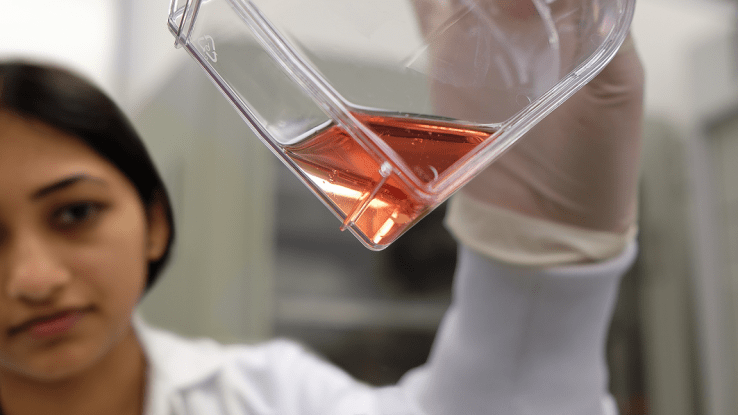
One of the scientists donned blue rubber gloves and was working with dishes of tumor cells inside a glassed-off testing area. de Silva pulled out a clear box filled with red liquid from a refrigerator in the corner of the room. The box was the size of a Tupperware sandwich case.
“See those tiny, floating specs in the liquid? Those are my dad’s tumor cells,” he told me.
de Silva explained how brain cancer cells and their various mutations make ideal subjects for testing. “They grow quickly and readily in three dimensions as spheroids, simulating actual tumors,” he said.
Testing can be done in various mutations, and myriad combined drugs can be updated for the individual patient on the fly using the Notable Labs method.
de Silva then pulled out a black carton punctured with tiny squares and explained how the liquid and cells get dropped into each square. The cells float to the bottom and are put into the special machine for a series of tests. Various mixtures of drugs are added to each square to see what works the best on that particular tumor. Combinations of each drug are then prioritized for efficacy, safety and tumor penetration and then sent to the patient’s doctor to evaluate.
Notable Labs is exclusively focused on brain cancer treatments right now. There are various reasons for this, but the biggest for de Silva is the fact that brain cancer patients have so few alternative options at the moment.
Unfortunately Notable Labs could not find a combination quickly enough to save de Silva’s dad. He succumbed to his brain cancer a week and a half ago, exactly 15 months since his diagnosis.
I asked de Silva how he was able to carry on with a fledgling startup so soon after losing his father. He told me with a sense of purpose in his voice that he was more determined than ever to find a better option of treatment for cancer patients like his dad.

Thursday, 26 February 2015

Google Starts Testing Mobile App Ads In The Google Play Store

Google announced this morning the launch of a pilot program which will allow mobile application developers the ability to advertise their apps directly within the Google Play store. These ads, which will initially be made available to advertisers already running search ads on Google.com, will also only be shown against Google Play search results. That is, they won’t just randomly appear in other sections of Google Play, like category pages or stuffed in the middle of Google Play’s Top Charts.
Instead, advertisers will be able to bid on ads that match a particular search query, like “hotel apps” or “coupon app,” for example.
Their mobile application would then appear at the top of the ranked search results returned from Google Play’s store, where it looks exactly the same as any other result except for the fact that it will be flagged as an ad via the small “Ad” button that appears under the app’s name.
As the company explains in a blog post this morning, its 100 billion-plus Google.com searches each month have improved content discovery for users and advertisers alike and now the search ads on Google Play will do the same for app publishers.
Specifically, the program will better allow newcomers and smaller developers the chance to compete and gain visibility in an app store that Google says now tops over a million applications.
Search Advertisers Are First To Test
There are few details being offered as to the program specifics at this time, because it’s only now entering pilot testing. For the time being, the ads will run just in the latest version of the Play Store mobile app on Android smartphones, not on tablets, or on the mobile or desktop web. And only a small number of consumers will actually see the new ads at first.
We understand that potential advertisers were identified automatically and invited to participate in the program via email, and those who chose to do so aren’t actually paying for their ads at this time. Rather, the pilot period is meant to allow the app publishers and users alike a time to test and provide feedback on a number of things, including the mix of ads, how keywords are targeted, how many ads are shown in the search results, and to what extent these Google Play ad campaigns will influence the Top Charts’ algorithms in the future, among other things.
GooglePlay-ads2 (1)
That latter item will require careful attention, as an app maker buying app store ads could very easily boost their downloads at a rate that would otherwise push their app to the top of the  store’s charts. But that wouldn’t necessarily mean their app had grown popular with users, but rather that they had paid for the exposure and clicks. It will also be interesting to see how Google addresses click fraud in the new store, as competitors may try to eat through each other’s ad budgets.
We also understand that there’s no way for advertisers or users to opt into these trials at present. Google isn’t saying how long the program will be in pilot testing, nor will it give a broader time-table for a public beta or public launch. It also won’t confirm how many advertisers are in the initial pilot.
In addition, beyond being the means of selecting advertisers for the trials, there’s no connection between search ads on Google.com and those on Google Play at this time. It’s unclear if in the future, however, current search advertisers will be given preference to join the Google Play advertising program when it opens up to more participants.
Google’s Role In The Mobile App Age
It’s not surprising that Google is introducing mobile app ads into its app store ahead of rival Apple, given the nature of its core business. It’s actually a logical next step for the company in a world that’s increasingly mobile. After all, the move to mobile is becoming a threat to Google’s advertising business. According to data from Flurry, only 14% of the time users spent on their smartphones was in the web browser in 2014, down from 20% the year prior. And the web is where Google’s ads have traditionally appeared.
A number of tech companies like Facebook, Twitter and Yahoo, as well as Google, have been targeting their mobile user base with ads that prompt users to download apps or re-engage with apps they already have installed. But Google will now be the first major OS maker that actually allows app publishers to advertise directly in its app store search results.
google-play-ads
That being said, it’s worth noting that Apple, too, has experimented to some extent in this area. It has tested “ads” – if you can call them that – that appear against select search terms in its iOS App Store. These ads in the past have promoted Apple’s own products or features. For example, a search for “music” once showed a search result card for iTunes Radio before other results, and today a search for “maps” on the App Store points to Apple’s editorial collection of map apps. While not the same kind of “ads” that Google is rolling out, it’s clear that Apple also understands the value of being in that first position.
The question is now whether or not they’d also be willing to sell access to that spot, like Google is.
Also of interest, Google used today’s announcement of the Google Play ad pilot to offer an update on its payouts to Android app developers. At its I/O conference last year, Google said it has paid out $5 billion to app developers in year prior. Today, it says that number has climbed to $7 billion. While that’s still short of the $10 billion Apple recently announced, it does show that Google is closing the gap quickly when it comes to revenue.

Friday, 20 February 2015

FDA Authorizes 23andMe to Market Genetic Testing For Bloom Syndrome

The U.S. Food and Drug Administration has given 23andMe clearance to begin selling kits for the genetic testing of Bloom Syndrome.
This is a rare recessive gene disorder that is characterized by shorter height and a predisposition to develop cancer. Parents of children with Bloom Syndrome don’t exhibit any symptoms of the disorder.
23andMe’s direct-to-consumer genetic test allows someone to see if they have a specific gene variant for Bloom Syndrome and helps parents know if they could potentially pass on the gene that would cause their children to have the disorder.
This is a significant ruling from the FDA. 23andMe had been ordered to stop selling at-home testing kits after not meeting the necessary FDA approval to do so back in 2013. The kits tested for 254 different kinds of disease markers. The FDA had classified these kits as medical devices for that reason and determined that it required regulatory approval before being sold to the public. This is the first time the FDA has approved this sort of test without a doctor’s approval.
It gives 23andMe a regulatory framework for future submissions— Anne Wojcicki
The FDA has classified the Bloom Syndrome carrier screening tests as class II, meaning the kits have special controls in place for direct-to-consumer marketing. The kits are also intended for exemption from FDA pre-market reviews, according to the FDA.

Thursday, 19 February 2015

Indiegogo Testing Way To Refund Money If Crowdfunded Project Does Not Ship

Indiegogo is trying to answer crowdfunding’s biggest question: How do you get your money back if the product never materializes? Called Perk Insurance, the optional coverage will allow backers to receive a full refund

Indiegogo Testing Way To Refund Money If Crowdfunded Project Does Not Ship

Indiegogo is trying to answer crowdfunding’s biggest question: How do you get your money back if the product never materializes? Called Perk Insurance, the optional coverage will allow backers to receive a full refund


© 2013 Tech Support. All rights resevered. Designed by Templateism

Back To Top