Postmates Will Deliver Bastian Lehmann Via Bike To The Disrupt New York Stage Microsoft today announced that it will consolidate its Visual Studio Premium and Ultimate offerings for enterprises into a single product once it launches Visual Studio 2015 later this year. Now called Visual Studio Enterprise With MSDN, this new version will include all of the features developers were getting with Visual Studio Ultimate (IntelliTrace in production, CodeLense support, etc.).
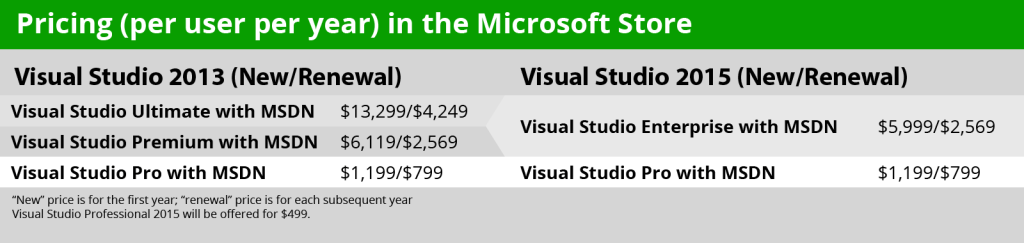
It’s also dropping the price of this new Enterprise version to slightly below the old price of the Premium edition. Enterprise with MSDN will now cost $5,999 for the first year and $2,569 for subsequent years (the old price for Premium was $6,119 for the first year and $2,569 from then on). That’s a 55 percent price drop for current Ultimate subscribers.
The price of Visual Studio Pro, the company’s offering for individuals and smaller teams, will remain at $1,199 for the first year and $799 for renewals.
It’s worth noting that Microsoft will continue to offer a standalone, non-subscription version of Visual Studio Professional, too, for $499.
Now there’s one wrinkle to this story. Enterprises that currently have volume licensing deals are probably getting a better price for Premium right now than for the new Visual Studio Enterprise edition. Microsoft tells me that the typical user there pays $3,573 for the first year and $1,312 for the renewal and that it expects the volume price for Enterprise to be $4,466 (and $1,640 for renewals).
As Microsoft’s general manager for Cloud and Enterprise Developer Platform Marketing and Worldwide Sales Mitra Azizirad told me earlier this month, the company will offer these Premium users the ability to renew their subscription at the old price for the calendar year after the launch of Visual Studio 2015. After this renewal, they will be paying roughly 25 percent more than they are now for the Enterprise version, but the company argues that they are also getting far more features than before.
Azizirad noted that Microsoft’s enterprise customers had been asking for a better way to standardize their Visual Studio deployments across the company, and today’s announcement reflects its attempt to address this.
Last year, Microsoft probably made its boldest Visual Studio move yet when it launched an (almost) fully-featured free Community edition of the application that included support for extensions — something the previous (and very limited) free versions never offered. Microsoft tells me that it has seen over 2 million downloads of the Community edition since it launched.
Related ArticlesMicrosoft's Visual Studio Online Now Lets Developers Add Unlimited Stakeholders For FreeMicrosoft Previews New Azure Portal, Integrates Visual Studio Online And Basic Code EditorMicrosoft Updates Azure With Deeper Visual Studio Integration, Puppet And Chef Support
As part of the Visual Studio 2015 updates, some of the features that were previously only available in high-priced versions will also move down the ladder. CodeLense, for example, is now available in Visual Studio Professional and the free Community edition is getting support for PowerPoint storyboarding.
“We want to make the right moves to bring the most popular features to the most developers as possible,” Azizirad told me. “This is really a move in terms of accessibility.” She also noted that Microsoft wants to show developers that it is listening and responding to their needs.
So how does all of this work out for existing Visual Studio subscribers? Mitra tells me that all active premium customers will get a free upgrade to the enterprise version, whether they bought Premium or received it through programs like BizSpark or the Microsoft Partner Network.
Microsoft today announced that it will consolidate its Visual Studio Premium and Ultimate offerings for enterprises into a single product once it launches Visual Studio 2015 later this year. Now called Visual Studio Enterprise With MSDN, this new version will include all of the features developers were getting with Visual Studio Ultimate (IntelliTrace in production, CodeLense support, etc.).It’s also dropping the price of this new Enterprise version to slightly below the old price of the Premium edition. Enterprise with MSDN will now cost $5,999 for the first year and $2,569 for subsequent years (the old price for Premium was $6,119 for the first year and $2,569 from then on). That’s a 55 percent price drop for current Ultimate subscribers.
The price of Visual Studio Pro, the company’s offering for individuals and smaller teams, will remain at $1,199 for the first year and $799 for renewals.
It’s worth noting that Microsoft will continue to offer a standalone, non-subscription version of Visual Studio Professional, too, for $499.
Now there’s one wrinkle to this story. Enterprises that currently have volume licensing deals are probably getting a better price for Premium right now than for the new Visual Studio Enterprise edition. Microsoft tells me that the typical user there pays $3,573 for the first year and $1,312 for the renewal and that it expects the volume price for Enterprise to be $4,466 (and $1,640 for renewals).
As Microsoft’s general manager for Cloud and Enterprise Developer Platform Marketing and Worldwide Sales Mitra Azizirad told me earlier this month, the company will offer these Premium users the ability to renew their subscription at the old price for the calendar year after the launch of Visual Studio 2015. After this renewal, they will be paying roughly 25 percent more than they are now for the Enterprise version, but the company argues that they are also getting far more features than before.
Azizirad noted that Microsoft’s enterprise customers had been asking for a better way to standardize their Visual Studio deployments across the company, and today’s announcement reflects its attempt to address this.
Last year, Microsoft probably made its boldest Visual Studio move yet when it launched an (almost) fully-featured free Community edition of the application that included support for extensions — something the previous (and very limited) free versions never offered. Microsoft tells me that it has seen over 2 million downloads of the Community edition since it launched.
Related ArticlesMicrosoft's Visual Studio Online Now Lets Developers Add Unlimited Stakeholders For FreeMicrosoft Previews New Azure Portal, Integrates Visual Studio Online And Basic Code EditorMicrosoft Updates Azure With Deeper Visual Studio Integration, Puppet And Chef Support
As part of the Visual Studio 2015 updates, some of the features that were previously only available in high-priced versions will also move down the ladder. CodeLense, for example, is now available in Visual Studio Professional and the free Community edition is getting support for PowerPoint storyboarding.
“We want to make the right moves to bring the most popular features to the most developers as possible,” Azizirad told me. “This is really a move in terms of accessibility.” She also noted that Microsoft wants to show developers that it is listening and responding to their needs.
So how does all of this work out for existing Visual Studio subscribers? Mitra tells me that all active premium customers will get a free upgrade to the enterprise version, whether they bought Premium or received it through programs like BizSpark or the Microsoft Partner Network.
 Phhhoto, perhaps the only social network to have first launched as a physical party product aimed at the enterprise, has topped 1 million registered users over the course of the past nine months. Users have posted upwards of 10 million Phhhotos to the platform.
 For a year, the Phhhoto team built out Phhhoto Pro to offer at parties and different events for a negotiable fee, while secretly working on an app that consumers could use whenever they want from their own device.
 tumblr_nkrot7MEiy1tgxst7o1_500
  tumblr_nkz3j0wPE91tgxst7o1_500
  tumblr_nl0tnvMU9H1tgxst7o1_500
  tumblr_nl0txbjAdC1tgxst7o1_500
  tumblr_nlq85s93bp1tgxst7o1_500
  tumblr_nlt2umYmyq1tgxst7o1_500
  FiftyThree has spent the last several years making products to increase creativity among users. Now the company has an eye on producing new tools not just for the consumer market, but that enterprise and education users could also leverage. To help with that, the company is also announcing it has raised $30 million in new financing from New Enterprise Associates.
 Thanks to a city ordinance passed last fall, this will be the first year on-demand ride services like Uber and Lyft will be competing for passengers in Austin during SXSW. As both companies prepare to meet demand that comes from the city’s biggest event of the year, Uber and Lyft will be urging passengers in Austin to share rides with strangers.
 Quite a few reports circling the web this week appear to indicate a tightening of WhatsApp’s policy toward the usage of third-party WhatsApp client applications. That is, word has it that those using an unofficial app will be banned from WhatsApp for life. However, that’s not exactly the case, WhatsApp explains. In fact, there’s been no larger policy shift since we last reported on the now Facebook-owned company’s crackdown on third-party app usage earlier this year.
 The problem is that there’s confusion around this terminology of a “lifetime ban.” That makes it sound like users are being banned from WhatsApp forever, but that’s not the case.
 Messaging app Viber has quietly made its games service available for all users worldwide following a two month pilot in five countries.