Mozilla Alum Jay Sullivan Lands At Groupon As Its New Head Of Product A Mexican educational psychologist duo has teamed up to build toys for blind or visually impaired kids. The first device they’re building is a wearable game called Smash-a-ball — pictured above in prototype form — which is being designed to help kids’ cognitive development.
The toy will consist of a backpack (and possibly also a wrist-based wearable, depending on how much funding they raise) which provides tactile (rather than visual) feedback which the kids then have to copy/pattern-match by hitting the corresponding buttons on the main board. Other games are in the works.
“When the child is wearing the backpack he will get tactile stimulus from the backpack in a way that he/she has to mimic with the main board, as fast and precise possible,” explains co-founder Pedro Bori. “With this first game mods, they will enhance their cognitive development in key skills like body and spatial awareness, increasing the reaction rate and the memory, as well as building a more solid self-esteem.
“With these skills promoted, we can say they can adapt better to new spaces and places, they will avoid accidents at dining table our schools desk, as well as in the streets when they get warned by possible hazard, because they’ll react faster.”
Although the pair started work on the concept back in 2012, in Mexico, they founded their startup in Scotland last May after winning a place on the UK Trade and Investment’s Sirius Programme, which supports international graduate entrepreneurs. They’ve now taken to Kickstarter to try to raise £100,000 in crowdfunding to turn their current prototype into a polished product.
Here’s what they’re hoping to turn Smash-a-ball into if they’re able to pull in enough funding:
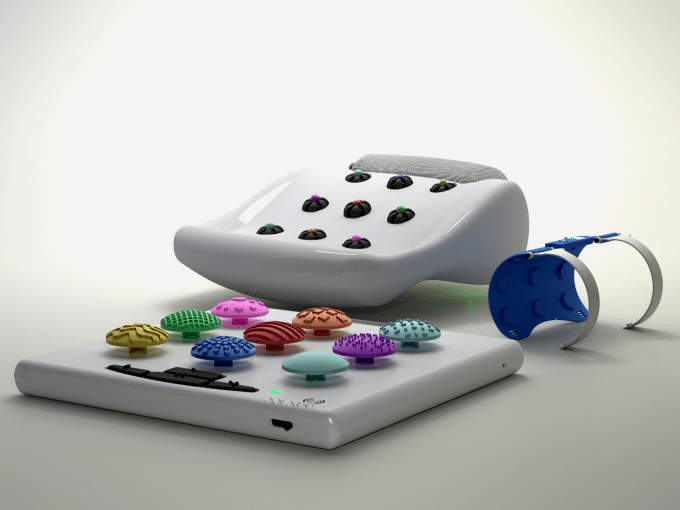
The Smash-a-ball prototype was built by a California-based engineering team, given the co-founders lack of expertise in building hardware. But the team has now expanded to include industrial design and mechanical engineers and app developers, as it plans to develop a range of toys for the blind and visually impaired, including non-electronic toys and also apps — but all “with the same mindset”, as Bori puts it, to give “a fun and entertaining option to VI&B children as while they enhance their cognitive development”.
The team has built three prototypes at this stage in the product’s development — including a working prototype which they’ve been using for testing and getting feedback from kids, parents and teachers. He says they’re also in the process of rewriting their software to make it more user-friendly. And they’re planning on expanding the games that will be able to run on the Smash-a-ball hardware — with new games being side-loaded via USB.
“About the development work is left to do, is to finish to get the contracts for the PCB, mould injection, parts. As well as to finish the new software version so we can deliver our first wave with the newest software,” adds Bori.
If they hit their funding goal — they have a ways to go there, with just over £11,000 raised of their £100,000 target at the time of writing — they’re hoping to get Smash-a-ball in the hands of backers by September.
A Mexican educational psychologist duo has teamed up to build toys for blind or visually impaired kids. The first device they’re building is a wearable game called Smash-a-ball — pictured above in prototype form — which is being designed to help kids’ cognitive development.The toy will consist of a backpack (and possibly also a wrist-based wearable, depending on how much funding they raise) which provides tactile (rather than visual) feedback which the kids then have to copy/pattern-match by hitting the corresponding buttons on the main board. Other games are in the works.
“When the child is wearing the backpack he will get tactile stimulus from the backpack in a way that he/she has to mimic with the main board, as fast and precise possible,” explains co-founder Pedro Bori. “With this first game mods, they will enhance their cognitive development in key skills like body and spatial awareness, increasing the reaction rate and the memory, as well as building a more solid self-esteem.
“With these skills promoted, we can say they can adapt better to new spaces and places, they will avoid accidents at dining table our schools desk, as well as in the streets when they get warned by possible hazard, because they’ll react faster.”
Although the pair started work on the concept back in 2012, in Mexico, they founded their startup in Scotland last May after winning a place on the UK Trade and Investment’s Sirius Programme, which supports international graduate entrepreneurs. They’ve now taken to Kickstarter to try to raise £100,000 in crowdfunding to turn their current prototype into a polished product.
Here’s what they’re hoping to turn Smash-a-ball into if they’re able to pull in enough funding:
The Smash-a-ball prototype was built by a California-based engineering team, given the co-founders lack of expertise in building hardware. But the team has now expanded to include industrial design and mechanical engineers and app developers, as it plans to develop a range of toys for the blind and visually impaired, including non-electronic toys and also apps — but all “with the same mindset”, as Bori puts it, to give “a fun and entertaining option to VI&B children as while they enhance their cognitive development”.
The team has built three prototypes at this stage in the product’s development — including a working prototype which they’ve been using for testing and getting feedback from kids, parents and teachers. He says they’re also in the process of rewriting their software to make it more user-friendly. And they’re planning on expanding the games that will be able to run on the Smash-a-ball hardware — with new games being side-loaded via USB.
“About the development work is left to do, is to finish to get the contracts for the PCB, mould injection, parts. As well as to finish the new software version so we can deliver our first wave with the newest software,” adds Bori.
If they hit their funding goal — they have a ways to go there, with just over £11,000 raised of their £100,000 target at the time of writing — they’re hoping to get Smash-a-ball in the hands of backers by September.
 “Oh, Apple’s making a luxury watch thing, of course it hired the CEO of Burberry to pitch it.” That’s the common line of thinking when it comes to how Apple will change its retail operations to sell the watch.But I think that’s shortsighted, and ignores several realities about Apple then and now — and whether Apple is actually a luxury retailer.The Apple Watch is absolutely going to require a different school of thought when it comes to instructing users in person. I’d actually argue that the iPhone really needed a different retail experience, too, but it never got one. It was plopped on the blonde wood tables alongside the Macs. As it got more popular it made the rotation to the front of the stores and took over iPod display areas and eventually the accessory walls.The iPad, on the other hand, was a natural fit — as an alternative laptop it was at home alongside Apple’s other computing products.A couple of years ago, independent analyst Horace Dediu noted that there had been a ‘quantum leap’ in Apple retail sales from 2012 to 2013. His conclusion on the cause? The iPad’s natural store fit:“Let’s remember also the comment from Ron Johnson at the time of the iPad launch. He said that it was as if the stores were designed for a product like the iPad. In other words, the iPad is something that needs to be discovered with a retail experience. You can sense this when you visit the stores and the placement of the iPads within. It all points to a something more profound: that the stores are brand ambassadors. Apple products create a purchase decision by speaking directly to the users. For the type of product Apple makes, that conversation can only happen face-to-face. The place where this meeting happens is the store.”The Apple Watch is not at all a natural fit for Apple’s current retail stores. And the iPhone could use some upgrades, as well.But Apple didn’t hire Angela Ahrendts because it’s making a watch. No company as forward-thinking as Apple makes a hire as big as that based on a single product. When you look at Apple’s recent organizational changes, it’s clear that it’s actually finally rejiggering its machinery to produce and sell its much more personal computers.The massive success of the iPhone wasn’t something it was possible to prepare for. And the iPad was Apple finally getting around to the business of making the large-screen device it wanted to before it had to settle for ‘pocketable’. Both of those businesses have turned out incredibly well, and have given Apple the runway needed to figure out where to go next in order to avoid the innovator’s dilemma (again).The Ahrendts hire is interesting on a few levels. She was CEO but happy to go to Apple as ‘just’ an SVP — albeit an incredibly well-compensated one (good for her).She’s done an incredible job with Burberry — cracking the hard nut of injecting desire into a brand assumed to be on the decline. In contrast, most folks don’t see what’s needed at Apple retail as “obvious,” but I think there are big changes coming in payments, store flow, show process and more. Since I started writing this story months ago, we’ve actually received some hard confirmation that a new shopping experience is coming to Apple retail, along with some rumors of what shape that experience might take.Apple is crafting a new process for retail employees, with new kinds of questions to ask people buying a watch. And there are rumors that the watch-buying experience will be much more like one you’d have in a jewelry store rather than an electronics store.Once you take Ahrendts into account you also see how all of the recent hires Apple has made are gearing Apple to make a big shift not just into “a watch” but on personal, even wearable, computing. It needs people who understand things that humans wear and choose to fit their personality. And it needs people who know how to sell those things. This is a far different tack than the one Apple has been on for the past decade. The one where it explicitly tells people how the things they own should look and how they should make them feel. Aluminum, slim, plastic, shiny, whatever. I think it signals big moves. Yes, it’s a great hire, period. but also momentous in terms of how Apple sells.And we might actually see a woman on Apple’s stage tomorrow, woo!One constant conversation around Apple is whether it is or is not a luxury brand. In some minds, the gold Apple Watch Edition has sealed the deal. It’s obviously being sold on the merits of its chemical composition, not its functionality.But what if Apple produced a hardened gold iPhone? Is an item still a luxury if it’s your primary computer? What if it’s your only car? Your only watch? I’d argue that the high-end Apple Watch isn’t about being “luxe,” it’s about personal statement and sentiment.A billionaire still can’t buy a better phone than you or I (if you’re a billionaire reading this, hi), but they can certainly buy one that makes them feel differently. If someone with the means wants to buy an iPhone and have it coated in precious liquid metal, why not? And if Apple wants to facilitate that, then all the better.The argument that Apple is doing something awful by offering a more expensive item that works the same way as a lesser expensive item is stupid.The fact that the version of the Apple Watch that could cost thousands works the same as the one that costs a few hundred is actually more friendly to everyman market, not less. The common logic is that if someone is buying something made of gold rather than a functional aluminum, they’re being wasteful or silly. But if you’re the kind of person who believes you’re being smarter by buying the least expensive, most utilitarian version and you look down on someone wearing a precious metal, then you’re engaging in the exact same kind of snobbery — just in reverse.To put it simply, it’s not about luxury, it’s not about how it works — it’s about how it makes you feel.Apple is in the process of creating and selling a new class of product that is based on feeling. And it needed a retail chief who understands that it’s going to be different to sell that than something that sits on your desk.In reality, Apple started selling wearable devices in 2007. When something is only one thin layer of cloth away from your skin, the majority of your waking hours, that’s a wearable piece of technology, regardless of whether it has a clasp or not. And that’s not even mentioning Apple’s still somewhat nascent home-automation efforts. But it never changed the way that it was presenting those items to people in stores or messaging what they will do for you in a sales environment. That needs to happen now.And if those changes are made successfully, I think we can expect another quantum leap for Apple retail.
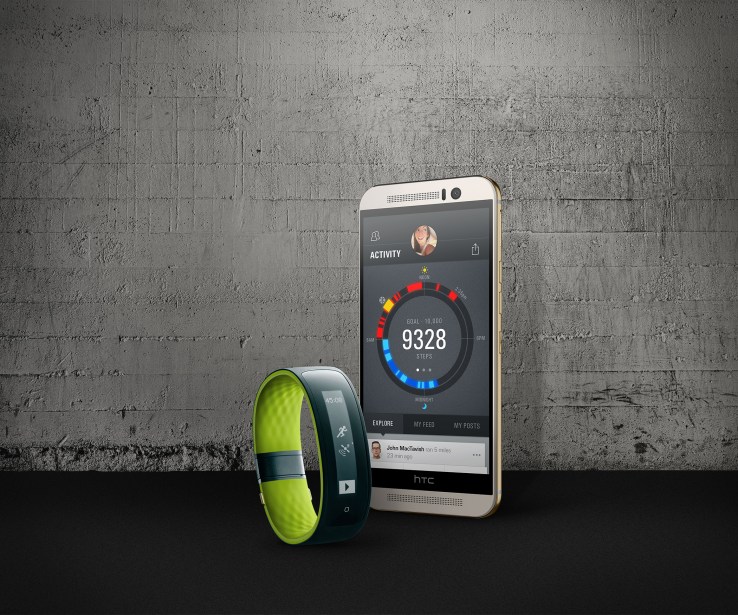 HTC has just announced it’s getting into wearables, with a fitness band, drawing on a strategic partnership it announced earlier this year with fitness gear maker Under Armour — who will be supplying the tracking software that the band hooks into.
 HTC_Grip_3
  HTC_Grip_2 View Slideshow Previous Next Exit