Rakuten To Put Its Bitnet Investment To Work And Accept Bitcoin Worldwide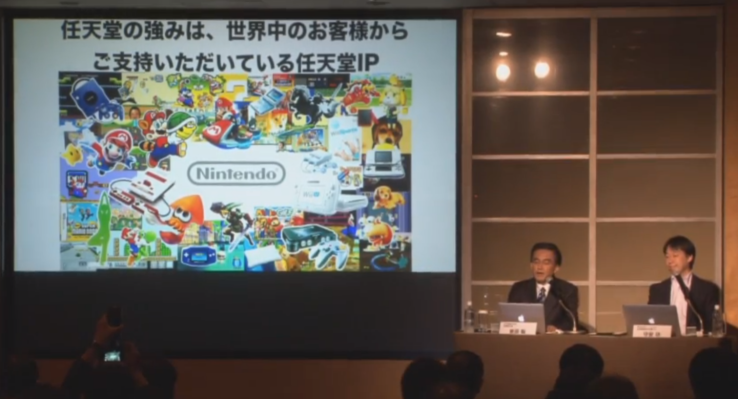 Nintendo is finally bringing its games and characters to mobile after the company surprised the tech world with an alliance with Japanese mobile gaming firm DeNA.
The duo announced a collaboration that will see them jointly develop games for “smart devices.” Secondly, a service that lets users play games across a variety of devices, including mobile devices, PCs and Nintendo’s own consoles like the 3DS and Wii U is slated to launch “in the fall of 2015″.
Nintendo said that it will create new titles from the ground up, rather than porting existing games from its consoles so as to “ensure the quality of game experience that consumers expect” from the coming together.
In what may be music to Nintendo fans — like this one — the companies said that “all Nintendo IP will be eligible for development and exploration by the alliance.” That said, the duo will not flood the market with vast numbers of games, the approach appears to be qualitative rather than quantitative.
At a joint-press conference, Nintendo President Satoru Iwata revealed that talks began as early as the summer of 2010, but became more concrete last year. Iwata admitted that Nintendo wasn’t able to transition to its handheld consoles “as smoothly as expected.” He denied that the growth of mobile means that the business of dedicated games consoles is dead but said it would be a waste to not look at opportunities with smartphones.
“We have come to hold a stronger passion and vision for the video games console” with this decision, Iwata said. Essentially, he believes that compelling mobile games can act as a “bridge” that pushes more consumers to buy dedicated Nintendo games consoles.
The alliance will see both sides make 22 billion yen ($181 million investments) in each other. That corresponds to around 10 percent of DeNA stock for Nintendo, while DeNA is picking up 1.24 percent of Nintendo.
Founded in 1999, DeNA may be less known outside of Asia, but it is a multi-billion dollar mobile games firm in its own right. It initially emerged with the growth of web-based mobile games in Japan and its Mobage service, but over the past few years it has transitioned into apps making acquisitions along the way, including the $400 million purchase of Ngmoco, and social games maker Punch.
That transition hasn’t been easy for the company, particularly with competition from the growth of new, dedicated mobile gaming firms that have focused on apps from day one. DeNA’s most recent financials saw revenue dip 17 percent year-on-year to $287 million. Operating profit was down 55 percent to $43 million, so it’s fair to say that this tie-in with Nintendo could be a very important turning point.
Nintendo is finally bringing its games and characters to mobile after the company surprised the tech world with an alliance with Japanese mobile gaming firm DeNA.The duo announced a collaboration that will see them jointly develop games for “smart devices.” Secondly, a service that lets users play games across a variety of devices, including mobile devices, PCs and Nintendo’s own consoles like the 3DS and Wii U is slated to launch “in the fall of 2015″.
Nintendo said that it will create new titles from the ground up, rather than porting existing games from its consoles so as to “ensure the quality of game experience that consumers expect” from the coming together.
In what may be music to Nintendo fans — like this one — the companies said that “all Nintendo IP will be eligible for development and exploration by the alliance.” That said, the duo will not flood the market with vast numbers of games, the approach appears to be qualitative rather than quantitative.
At a joint-press conference, Nintendo President Satoru Iwata revealed that talks began as early as the summer of 2010, but became more concrete last year. Iwata admitted that Nintendo wasn’t able to transition to its handheld consoles “as smoothly as expected.” He denied that the growth of mobile means that the business of dedicated games consoles is dead but said it would be a waste to not look at opportunities with smartphones.
“We have come to hold a stronger passion and vision for the video games console” with this decision, Iwata said. Essentially, he believes that compelling mobile games can act as a “bridge” that pushes more consumers to buy dedicated Nintendo games consoles.
The alliance will see both sides make 22 billion yen ($181 million investments) in each other. That corresponds to around 10 percent of DeNA stock for Nintendo, while DeNA is picking up 1.24 percent of Nintendo.
Founded in 1999, DeNA may be less known outside of Asia, but it is a multi-billion dollar mobile games firm in its own right. It initially emerged with the growth of web-based mobile games in Japan and its Mobage service, but over the past few years it has transitioned into apps making acquisitions along the way, including the $400 million purchase of Ngmoco, and social games maker Punch.
That transition hasn’t been easy for the company, particularly with competition from the growth of new, dedicated mobile gaming firms that have focused on apps from day one. DeNA’s most recent financials saw revenue dip 17 percent year-on-year to $287 million. Operating profit was down 55 percent to $43 million, so it’s fair to say that this tie-in with Nintendo could be a very important turning point.
 Accredible, which provides online credentials as a service, is announcing a partnership today to provide digital certificates for Udacity’s burgeoning nanodegree program. The startup has created an API that pulls data from existing online learning platforms — in this case Udacity — and creates an online certificate that summarizes the student’s behavior and learning in a course.
 Accredible is not new to the online credentialing space. Launched nearly two-and-a-half years ago, in the height of the MOOC hysteria, the company was originally founded with a focus on self-reporting, meaning that students would populate a certificate with their own impressions of what they learned. Though a necessary step, reporting was non-uniform and highly subjective.
